Los informes PDF y Word están en chino e incluyen un resumen en inglés.
Resumen
Este resumen distingue los parámetros documentados del proyecto de las hipótesis paramétricas. Los cálculos no sustituyen la validación de la máquina concreta. El resumen inglés recoge los resultados y sus límites.
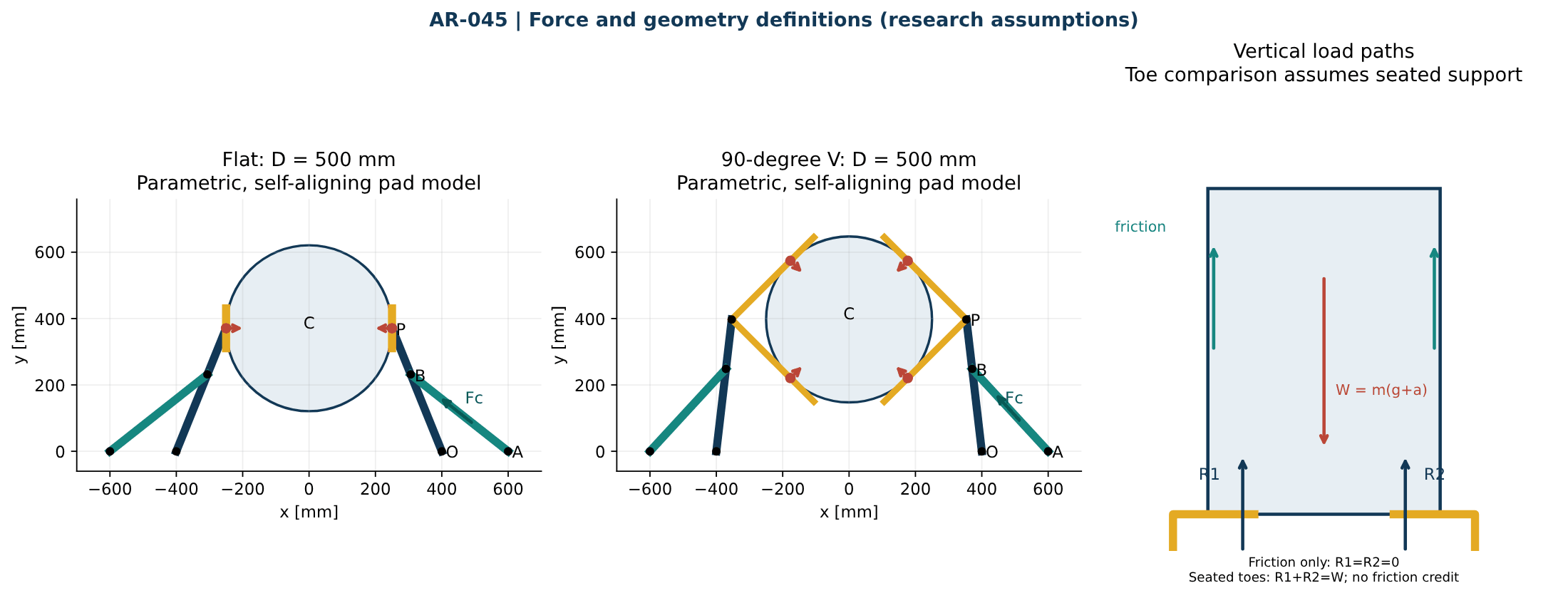
This study uses a dual-swing-jaw barrel clamp proposal with a rated working load of 310 kg and a stated diameter range of 310–620 mm as a structural reference. It derives the complete load path from cylinder chamber pressures to hinge moment, per-side closing resultant, contact-normal forces and vertical holding capacity. The source drawings establish the topology but do not establish cylinder size, production pivot coordinates, liner properties or allowable barrel-wall pressure. Numerical results therefore belong to an explicitly defined parametric model. For a 160 mm bore, a nominal chamber pressure of 0.625 MPa, cylinder force factor 0.90, linkage efficiency 0.95, workpiece mass 310 kg, upward acceleration 0.25g and friction coefficient 0.40, the flat-contact model produces 6.638–7.597 kN total scalar normal force and friction margins of 0.699–0.800. An ideal self-aligning 90-degree V model produces 9.884–12.463 kN and margins of 1.040–1.312. The 400 and 500 mm cases are research interpolation points between the documented endpoints. Pressure and friction scans reveal coupled slip and wall-pressure limits. Bottom support is evaluated through support reactions, eccentric bending and engagement, rather than a friction safety factor. Its illustrative toe-bending margin is 1.263; complete structural capacity remains unverified. The report supplies reproducible calculations and an original-part verification procedure without claiming equipment certification.
Keywords: barrel clamp; cylinder transmission; contact normal force; frictional holding; barrel-wall pressure; bottom support
Texto completo en chino
Los informes PDF y Word están en chino e incluyen un resumen en inglés.