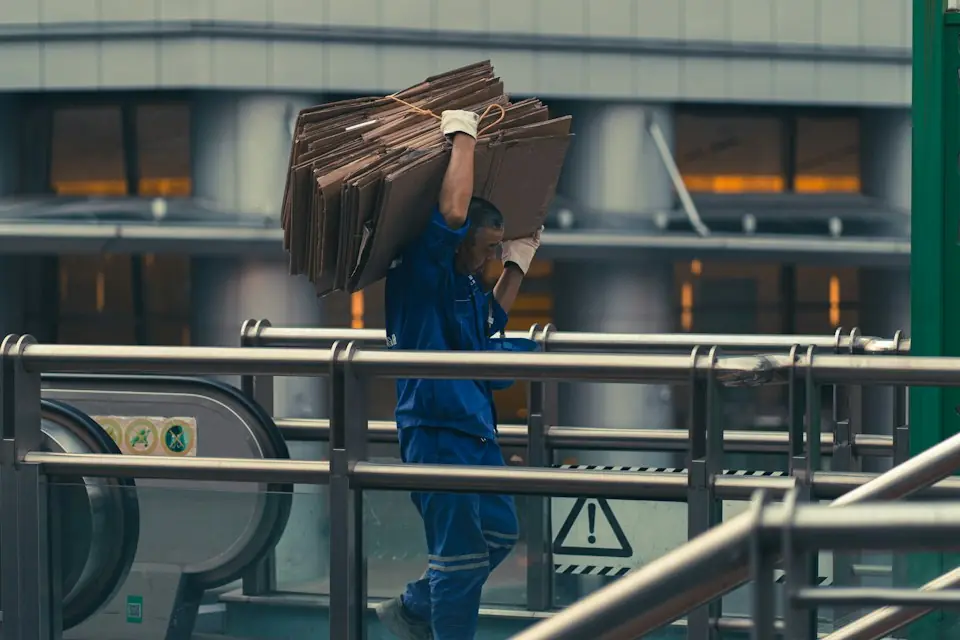
- Manual handling of heavy loads requires a combined assessment of weight and working conditions, recording posture, frequency, horizontal distance, pick and place heights, twisting, grip, cycle time and the environment.
- The Revised NIOSH Lifting Equation (RNLE), including RWL and LI, supports workstation comparison, improvement prioritization and reassessment before and after changes. RWL is not a statutory limit, and LI is not a medical diagnostic indicator.
- Low-frequency and high-frequency handling have different dominant risk mechanisms: the former is more closely associated with the load from an individual event, while the latter is more closely associated with cumulative fatigue and insufficient recovery. Develop assessment and improvement strategies for each pattern.
- Engineering improvements should follow "Elimination—Substitution—Engineering Controls—Administrative Controls—Personal Protective Equipment" in the hierarchy of controls. Mechanically assisted equipment such as lifting tables, Pneumatic Industrial Manipulators, and vacuum lifters is one form of engineering control; after deployment, re-evaluate the task to close the validation loop.
Published by: Jiangsu AUREK Intelligent Technology Co., Ltd. · Document No.: AUREK-WP-ERG-2026-001 · Version: V1.1 · Applications: initial risk screening in manufacturing, workstation engineering improvements, customer technical discussions and personnel training. The equations, worked examples, scores and tables support engineering risk screening, comparison and improvement decisions. Medical diagnosis, occupational disease assessment, recognition of work-related injuries and the application of regulations follow the relevant professional procedures separately. Download the full PDF at the top or end of this article.
00Abstract
Some loading and unloading, assembly, packaging and palletizing, warehouse logistics and short-distance transfers in manufacturing still depend on manual handling. Even where forklifts, overhead cranes, conveyors and automation cover the main material flows, temporary handling, nonstandard parts and frequent small-batch tasks require separate assessment. Evaluate individual item weight together with posture, frequency and the environment to identify how the same weight can impose different loads on the lower back, shoulders and neck, lower limbs, wrists and hands under different conditions.
This article establishes an assessment process covering people, equipment, the environment and work organization. Identify handling risks, record exposure indicators, and use the Revised NIOSH Lifting Equation (RWL and LI) for quantification and prioritization where its applicability conditions are met. Then select measures in the order of elimination, substitution, engineering controls, administrative controls and personal protective equipment. Worked examples, an example FMEA and a site observation form help safety, equipment, process and production personnel organize site assessments and post-improvement reassessments.
01Scope and boundaries of application
1.1 Applicable scenarios
This article supports risk identification and engineering improvements for heavy-load handling performed wholly or partly by people in manufacturing and related workplaces. Typical tasks include:
- Production-line loading and unloading, and short-distance transfers between workstations;
- workpiece picking, placing, turning and positioning during assembly;
- Packaging, palletizing, depalletizing and handling returnable containers;
- Sorting, replenishment and temporary handling in warehousing logistics;
- Temporary handling during equipment maintenance and changeovers, and handling of non-standard parts.
1.2 Assessment Scope and Interpretation
The assessment concerns the engineering risks of tasks and workstations. Medical diagnosis and determination of work-related injury follow the relevant professional and regulatory procedures, using factual evidence. NIOSH RWL, LI and company scoring forms support comparison and prioritization. Apply specific standard clauses, limits and mandatory requirements using the official texts.
| Assessment Topic | Engineering Interpretation | Application |
|---|---|---|
| Lower-Back Loading and Health Risk | Adverse handling conditions may increase low back musculoskeletal load and risk of injury | Record task exposure and employee health feedback |
| Weight and Applicable Requirements | Specific limits and compliance judgments should be based on applicable regulations, official texts of standards and corporate systems. | Assess task conditions and identify applicable requirements |
| Role of Mechanical Assistance | Mechanical assist equipment is one of the engineering control measures, and it still needs to match the workstation and operating process. | Match the workstation, tooling and operating procedure |
| LI and Improvement Priority | The higher the LI, the more unfavorable the task is relative to the recommended weight limit, and priority should be given to attention and improvement. | Use LI for task comparison and improvement prioritization |
| Verification After Equipment Introduction | Assistance equipment can reduce some exposures, but risk indicators and employee feedback still need to be retested after introduction. | Reassess remaining risks and any new risks |
Table 1. Risk interpretation and engineering application.
02Introduction: Why risk can’t just be about weight
2.1 After automation, why does manual handling still exist?
Site surveys should specifically cover short-distance movements outside the scope of automation, including picking and placing between workstations, at equipment edges and near custom grippers. Frequent changeovers, high-mix small-batch production, confined spaces and temporary tasks may combine low-level picking, extended reaching, twisting under load, poor grip and fast repetitive cycles. A short travel distance is not a reason to omit assessment.
2.2 Why traditional judgment based on weight alone is insufficient
Individual item weight is easy to record, but it must be interpreted together with movement conditions. Occasional handling close to the body at waist height differs in loading and risk mechanisms from bending to a low position, extended reaching, twisting under load or continuous high-frequency handling. Site records should cover weight, posture, frequency, distance, height, grip and the environment, linked to the workpiece, equipment, layout and operating cycle.
2.3 Research objectives
The method provides a practical workflow for manufacturing sites: identify manual handling hazards, record comparable exposure indicators, use RNLE results for engineering assessment and prioritization, distinguish improvements for low-frequency and high-frequency tasks, and select and verify measures using the hierarchy of controls.
03Main types of occupational health risks in manual heavy lifting
Risk identification separately examines localized musculoskeletal loading, accumulated fatigue and sudden loss of stability. The following sections describe movement characteristics to observe by the main body region under load and the work scenario, helping identify workstation improvements.
3.1 Lower back risks
Lower-back loading arises primarily from forward bending, holding the hands away from the body, rising under load, trunk twisting, and sudden loss of balance. When the workpiece center of gravity is far from the body or the trunk twists while rising, the lower-back muscles must generate a larger counter-moment to stabilize the body and load, which can increase fatigue, discomfort, soreness, and strain risk.
3.2 Shoulder and neck risks
Pickup or placement outside the comfortable working zone can require shoulder elevation, shrugging, extended reach or overhead movements. These actions require sustained effort from the shoulder and neck muscles to stabilize and move the load. High shelving, excessively high fixtures, prolonged raised-arm postures and repeated overhead movements are relevant loading scenarios.
3.3 Knee and lower limb risks
Picking up from a low level, squat lifting, handling on ramps or steps, and handling on slippery floors can increase loads on the knees, ankles, and lower-limb muscles. Frequent deep squatting, half-squatting, or turning while loaded can also increase lower-limb fatigue, instability, fall risk, and sprain risk.
3.4 Wrist and hand risks
Loads with no handles, smooth surfaces, sharp edges or an offset center of gravity, and tasks requiring a pinch grip, can increase grip force and alter wrist posture. This can increase fatigue and strain in the wrists, forearms and fingers, as well as the likelihood of dropped loads, impact injuries and incorrect placement.
3.5 Repetitive loading and risk of chronic fatigue
For high-frequency handling, record movements per unit time, task duration and recovery intervals together. Even relatively light items can cause accumulated fatigue when exposure is highly repetitive and recovery time is short. For infrequent heavy loads, focus on the peak load of each movement; for frequent light or medium loads, focus on accumulated fatigue. Select improvements for each type of task accordingly.
3.6 Acute sprain and accident risk
Slips, trips, unstable loads, uncoordinated team handling, obstructed aisles, sudden turns, restricted visibility and changes in floor level can contribute to acute sprains, crushing or impact injuries, and falls. These risks involve the environment and work organization as well as load weight.
04Sources of ergonomic risks for manual handling
Record data throughout picking, moving and placing: workpiece weight, start and end positions, handling frequency, hand-to-body distance, bending and twisting, grip conditions, floor conditions and recovery time within the cycle. Match these factors to the table below to identify items requiring further measurement.
| Source of risk | Engineering explanation |
|---|---|
| Weight per Handling Cycle | Weight is a basic source of loading. Greater weight generally increases the force required per movement and the consequences of instability. Interpret weight together with posture and frequency. |
| handling frequency | Frequency describes repetitions per unit time and influences available recovery time. Low-frequency tasks emphasize individual loading events; high-frequency tasks emphasize cumulative fatigue. |
| Cumulative Weight Handled per Shift | Unit weight × number of handling cycles per shift reflects total exposure intensity during the shift and is an important supplementary indicator for high-frequency tasks. |
| horizontal reach | Longer reach increases the moment that the lower back and shoulders must resist. Reducing horizontal reach can therefore be an effective improvement. |
| Pick and place height (starting point/end point) | Taking objects from the ground or below the knees may increase bending and squatting; placing objects above shoulder height may increase the load on the shoulders and neck. |
| vertical lift distance | The greater the height difference between the starting point and the end point, the more muscle groups are continuously involved in the handling process, and the higher the risk of fatigue. |
| Bending / twisting angle | Deeper forward bending increases lower-back moment, while twisting under load introduces asymmetry. Use turntables, slides or workstation layout changes to reduce these movements. |
| Grip conditions | Missing handles, smooth surfaces, sharp edges, off-center loads and flexible packaging can increase grip-force demand, adverse wrist postures and the risk of dropping the load. |
| workpiece size, shape and center of gravity | Large volumes, obstructed vision, shifted center of gravity, liquid sloshing and flexible materials can reduce controllability. |
| Transport routes and environment | Long distances, detours, steps and ramps, cross-flow, slipperiness, oil, insufficient lighting, heat and humidity, and limited space amplify handling risks. |
| Work Pace and Recovery Time | Equipment cycle time, order pressure, lack of buffers and micro-breaks can cause fatigue to continue to build up during a shift. |
Table 2: Main risk sources and engineering explanations for manual handling.
05On-site risk assessment index system
5.1 Basic exposure indicators
Record comparable exposure indicators using site observations, sampled video, tape measurements, weighing, shift records and employee feedback. Core indicators include item weight (kg), handling counts per hour and shift, cumulative weight per shift (kg/shift), horizontal carrying distance (m), horizontal hand distance H (cm), start and end heights (cm), vertical travel D (cm, the absolute difference between end and start heights), trunk twist angle A (°), grip quality (good/fair/poor), subjective fatigue score (0–10), discomfort feedback, environmental risk category and the handling aids in use.
5.2 Cumulative handling exposure
In high-frequency handling, unit weight alone does not represent exposure over the shift. The following two simple indicators may be used for preliminary screening:
5.3 Comprehensive risk screening score
Where complete NIOSH data or suitable site measurement conditions are unavailable, a 1–5 scoring scale can support initial screening and internal prioritization. Retain the associated working conditions with each score and revise the scoring system periodically using industry characteristics and historical data.
| Rating | risk level | Description |
|---|---|---|
| 1 | Low | Small weight, low frequency, good posture, stable environment, no obvious fatigue feedback |
| 2 | Relatively Low | There are a few adverse factors, but they last for a short time and personnel can recover. |
| 3 | Medium | At least one clearly unfavorable factor: weight, frequency, posture, distance or grip |
| 4 | Relatively High | Several adverse factors, with reports of fatigue, discomfort or minor incidents |
| 5 | high | Heavy loads or continuous high-frequency handling combined with bending or twisting, extended reach, adverse environmental conditions or recorded abnormal events |
Table 4. Recommended comprehensive risk screening scores.
06Applicability of Relevant Standards and Reference Frameworks
The reference frameworks address work systems, body dimensions, controls, human-machine interaction, manual handling and occupational hygiene respectively. Before applying them, check the official standard text for scope, limits and current status, then match the method to the site task. The table below explains the purpose of each method without listing specific mandatory clauses or limits.
| Standard/Reference System | How to use it in this article |
|---|---|
| GB/T 16251—2023 Ergonomic principles for work system design | Provides an overall framework for work-system design, considering human capabilities, loading, health risks, system performance and sustainable work through the interaction of people, equipment, environment and organization. |
| GB/T 10000—2023 Anthropometric Dimensions of Chinese Adults | It can be used as a human body size reference for workstation height, reach distance, operating space, passage and access height; specific values need to be checked with the official text. |
| GB/T 14775—1993 General ergonomics requirements for controller | May inform the design of control buttons, handles, pedals, control directions, legibility, and ease of operation to reduce secondary risks during equipment use. |
| GB/T 18978 series Human-system interaction ergonomics | Addresses human–machine interaction, displays, input, and human-centered design. Where equipment includes a display, alarm interface, or data-acquisition terminal, it may provide an interaction-ergonomics reference. |
| ISO 11228 Manual Handling Series | Provides background on international methods for evaluating manual lifting, carrying, pushing/pulling, and repetitive low-load work. Limits should not be quoted without verification. |
| Revised NIOSH Lifting Equation (RNLE) | Suitable for analyzing two-hand lifting/placement tasks, it can convert weight, horizontal distance, vertical height, lifting distance, twist, frequency and grip conditions into RWL and LI. |
| Occupational health related GBZ / GBZ/T standards | Where workplace physical factors, work intensity, heat, noise, dust, or occupational-health management are involved, an occupational-hygiene professional should assess the applicable standards. |
Table 5. Standards and reference methods.
07Engineering Interpretation of the Revised NIOSH Lifting Equation
7.1 Basic formulas
The Revised NIOSH Lifting Equation (RNLE) applies multipliers to a load constant for ideal conditions to calculate the Recommended Weight Limit for the task:
| symbol | meaning | Engineering explanation |
|---|---|---|
| RWL | Recommended Weight Limit | Engineering reference weights under specific operating conditions, used for task comparison and improvement ranking, are not legal limits, nor are they a guarantee of individual safety. |
| LC | load constant | The baseline load for ideal two-hand lift conditions is taken as 23 kg (approximately 51 lb) in the equation. |
| HM | Horizontal Multiplier | The farther the hand is from the body, the smaller the HM; reaching at long distances significantly reduces RWL. |
| VM | vertical height factor | VM decreases as the starting height moves farther from the reference height. |
| DM | Distance Multiplier | The larger the lift distance, the DM tends to decrease. |
| AM | Asymmetry Multiplier | The larger the trunk-twisting angle, the smaller the AM. |
| FM | Frequency Multiplier | The greater the handling frequency, the longer the duration, and the less recovery time available, the smaller the FM. |
| CM | Coupling Multiplier | The poorer the grip quality, the smaller the CM. |
| LI | Lifting Index | The ratio of actual load weight to RWL. A higher LI indicates less favorable conditions relative to the recommendation and a higher priority for review and improvement. LI is not a medical diagnosis. |
Table 6. RNLE symbols and multipliers.
7.2 Engineering significance of RWL and LI
RWL supports task design and risk comparison. Its multipliers are generally no greater than 1; greater horizontal distance, greater deviation of the starting height from the reference height, higher frequency, greater twisting or poorer grip reduces the corresponding multiplier and therefore the RWL. Analyze LI alongside employee feedback, observed fatigue, incident and abnormal-event records, cycle time and environmental information for workstation prioritization, option comparison and reassessment before and after improvements. It does not predict whether an individual will be injured.
7.3 Applicability Conditions
RNLE primarily applies to smooth, two-handed lifting and lowering while standing. Use other assessment methods and professional judgment for tasks outside these conditions, including one-handed lifting or carrying; team handling; pushing, pulling or dragging; seated or kneeling work or severely restricted space; work on ladders, steps or unstable support surfaces; extreme heat, cold or other special environments; and loads involving sudden impacts, moving live subjects or substantial liquid sloshing.
08Examples and explanations of typical working conditions
8.1 Working condition description and calculation
This worked example illustrates the calculation method. A 25 kg workpiece is lifted from a low pallet to a workbench with horizontal hand distance H = 45 cm, starting height V = 50 cm, vertical travel D = 70 cm, trunk twist angle A = 45°, frequency 2 lifts/min, duration 2 h and fair grip quality. A 2 h task with sufficient recovery falls in the moderate-duration category. To retain an additional conservative duration assumption, this example uses FM 0.65 from the longer-duration category (>2–8 h), rather than treating it as the table value for 2 h. The approximate example multipliers are HM 0.56, VM 0.93, DM 0.88, AM 0.86, FM 0.65 and CM 0.95.
8.2 Engineering explanation
In this worked example, the load exceeds the calculated RWL and LI is substantially greater than 1, so the task merits priority for improvement. Horizontal reach and the frequency multiplier under the conservative duration assumption are the main factors reducing RWL. Longer reach increases lower-back moment, while repeated exposure and limited recovery influence the frequency multiplier. The asymmetry multiplier also reflects the adverse effect of twisting under load. Use these results to prioritize layout, frequency and turning-movement improvements.
8.3 Directions for improvement
- Reduce unit weight, use smaller packages, or divide handling into batches;
- Raise the pickup point to approximately waist height, for example by using a lift table;
- Reduce horizontal reach and bring the workpiece closer to the body;
- Reduce trunk twisting under load by using a turntable, slide, or forward-facing layout;
- Improve gripping conditions by adding handles, tooling or trays;
- Reduce handling frequency and introduce buffers and job rotation;
- For high-frequency or continuous work, assess engineering controls such as lift tables, conveyor lines, pneumatic industrial manipulators, vacuum lifting devices and balancing hoists.
09Comparison between low-frequency handling and high-frequency handling
When comparing low- and high-frequency tasks at the same weight, also document posture, layout and recovery conditions. Low-frequency tasks require control of individual peak loads and instability; high-frequency tasks additionally require reductions in cumulative exposure and insufficient recovery.
| Comparison | Scenario A: low frequency, close to the body, occasional handling | Scenario B: High frequency, long-distance reaching, bending and twisting handling |
|---|---|---|
| weight | 25 kg | 25 kg |
| posture/distance | Pickup and placement at waist height, close to the body, with little or no twisting | Fetching objects from a low position, reaching for long distances, and twisting with weight |
| Frequency | Occasionally, such as several times per shift | Continuous high-frequency handling, for example 2 lifts/min or more |
| Main risk mechanisms | Single instantaneous load and instability consequences | Accumulated fatigue, insufficient recovery, and superimposed single high load |
| Typical signal | Some movements are difficult and there are occasional dangers | Fatigue during the shift, persistent discomfort reports and reduced efficiency |
| Improvement focus | Optimize single posture, gripping conditions and pick and place height | Reduce repetitive exposure, redesign workstation layouts and assess conveyors or mechanical assistance |
Table 9: Comparison between low-frequency and high-frequency handling (taking the same weight of 25 kg as an example).
10Manual handling risk level quick grading table
The following table supports rapid internal classification and improvement prioritization. Companies may refine the descriptions to reflect their industry, workforce, historical incidents and occupational hygiene management requirements. These classifications are not statutory risk categories.
| risk factors | Low | Medium | high | very high |
|---|---|---|---|---|
| Single weight | Lighter, stable control | Medium, requires significant effort | Heavy or close to the load capacity limit | Very heavy or off-center loads, or tasks barely completed even with additional assistance |
| handling frequency | Occasionally | periodic repetition | High frequency, less recovery | High frequency continuous, almost no recovery |
| handling distance | Short distance, clear route | medium distance | long distance or detour | Long distances, complex routes and crossing material flows |
| Pick and place height | near waist | below the knees or above the chest | Pickup from floor level or placement above shoulder height | Pick up items from the ground and place them overhead |
| Reach horizontally | close to body | medium reach | extended reach | Sustained extended reach |
| bend / twist | Basically upright, rarely turning around | Occasionally bending or turning around | Frequent bending or twisting when bearing weight | Frequent deep bending and rising under heavy loads, combined with frequent twisting |
| Grip conditions | Good handle, non-slip | Average grip | Handleless or smooth | No handles, combined with sharp edges, off-center loading or flexible packaging |
| Ground and environment | Level, dry floor and normal temperature and humidity | Local obstacles or mild environmental discomfort | Slippery, sloped, high temperature or insufficient lighting | Several adverse environmental conditions combined |
| Fatigue and feedback | No obvious fatigue | Fatigue after work, occasional feedback | Noticeable fatigue within a shift, reported by multiple operators | Persistent high fatigue with recorded abnormal events |
Table 10. Rapid manual handling risk classification: low, medium, high and very high. This consolidated excerpt is supported by the full itemized table in the PDF.
11Engineering Improvements and the Hierarchy of Controls
11.1 Hierarchy of Controls
Select improvements in the order of elimination, substitution, engineering controls, administrative controls and personal protective equipment. First eliminate or reduce unsuitable handling movements, then reduce exposure through changes to materials, layout and equipment, supported by management and protective measures. Personal protective equipment can reduce only certain exposures or consequences; it cannot replace workstation design, handling aids and process improvement.
| Hierarchy | Typical measures | Description |
|---|---|---|
| Elimination | Eliminate unnecessary manual handling, low-level pickup/placement, or turning under load | Highest priority; implement during process and layout design where practical |
| Substitution | Smaller packages, divided batches, standard containers, preloaded pallets and prepositioning fixtures | Reduce the load per movement and task variability |
| Engineering Controls | Lift tables, scissor lifts, turntables, roller and belt conveyors, balancing hoists, pneumatic industrial manipulators, vacuum lifting devices, AGVs, dedicated fixtures and workstation layout changes | Change exposure conditions through equipment, fixtures or layout |
| Administrative Controls | Job rotation, work-pace optimization, recovery intervals, work instructions, training, and inspections | Depend on implementation and supervision; support engineering controls |
| Personal Protective Equipment | Slip-resistant footwear, gloves, protective equipment and heat-stress prevention or cooling supplies | Supplementary protection requiring appropriate selection and correct use; retain the engineering improvements |
Table 11. Hierarchy of controls for handling risks.
11.2 Implementing Engineering Controls
- Prioritize high-risk workstations using RWL/LI, cumulative exposure, risk classification and employee feedback;
- Before introducing equipment, assess whether elimination, substitution or workstation layout changes can address the task;
- Select equipment using load, working radius, travel, fixture type, air and power supplies, space, cycle time and protective functions;
- Personal protection cannot replace engineering improvements, but can only be used as a supplementary measure for residual risks.
12Application of Mechanical Handling Assistance
Lift tables, pneumatic industrial manipulators, vacuum lifting devices and balancing hoists can provide the main load support, stabilization or positioning functions while operators remain involved in the relevant actions. Configure the equipment so that pick and place postures, operating pace and physical loading suit the task. Assess its suitability against the workstation conditions.
12.1 Tasks Suitable for Equipment Assessment
- High unit weight, or a need to hold, position, or turn the load for an extended period;
- Frequent repetitive handling, insufficient recovery and high cumulative exposure during the shift;
- Large pickup-to-placement height differences requiring frequent bending, raised shoulders or overhead work;
- Loads with no handles, an offset center of gravity, fragile or smooth surfaces, or a need for dedicated fixtures;
- Turning under load, extended reach, constrained posture, or spatial interference.
12.2 Tasks Requiring Additional Evaluation
- Very short production cycles that cannot accommodate the equipment movement time;
- Frequent product changes or widely varying load forms that are difficult to cover with suitable fixtures;
- Restricted space, substantial overhead-crane or material-flow interference, or limited installation options;
- Operations that require complex judgment, fine touch, or frequent abnormal handling;
- Workstations where process layout and fixture validation remain incomplete: improve the process before assessing equipment.
12.3 Secondary Risks Introduced by Equipment
Equipment selection and acceptance should check both effort reduction and safe operating conditions. Focus on handle position, buttons and control feedback, emergency stop accessibility, gripper suitability, release logic, air and power loss protection, and control of downward movement under heavy loads. Also check whether the equipment or load obstructs visibility or interferes with nearby equipment, overhead cranes or aisles. Include these secondary risks in the design assessment.
12.4 Post-Deployment Retesting and Closed-Loop Follow-Up
Use RWL / LI, cumulative exposure, risk classification and employee feedback to prioritize improvements. After equipment enters service, reassess posture, frequency, fatigue feedback and abnormal events on the same basis. Check whether risk indicators have decreased and whether new adverse movements have been introduced, completing the assessment—improvement—verification process.
13Typical Problems and Engineering Improvements
The table below links common problems to engineering measures and can support workstation improvement plans. Select measures using site measurements, cycle time and investment constraints, and check the listed expected effects through post-improvement reassessment.
| Typical issues before improvement | Improvement Direction | Engineering considerations | Expected Effect |
|---|---|---|---|
| Picking loads from the floor with frequent deep bending | Lifting pallet / scissor lift table | Keep pickup height near waist level and raise the load as items are removed | Reduce forward trunk bending and deep squatting |
| Picking and placing with extended reach | Workstation Layout Redesign | Reduce workbench depth and bring the load closer to the body | Reduce back torque |
| Turning under load before placement | Turntable or linear flow arrangement | Arrange forward-facing pickup and placement, using a turntable, slide table or roller conveyor | Reduce asymmetric loads |
| High-frequency repetitive handling | Conveyor line or mechanical assistance | Add conveyors and buffers, assess pneumatic industrial manipulators or balancing hoists, and optimize work pace and job rotation | Reduce repeated exposure and fatigue accumulation |
| No handle, difficult to grasp | Dedicated fixture or pallet | Add handles, fixtures, returnable containers or slip-resistant surfaces, and mark the center of gravity | Reduce wrist loading and dropped-load risk |
| The floor is slippery and oily | Anti-slip treatment and cleaning system | Provide slip-resistant flooring and drainage, with a cleaning and inspection routine | Reduce the risk of slips and instability |
| Handling in hot environments | Environmental and organizational improvement | Ventilation, heat insulation barriers, off-peak work, rest and hydration | Support sustained work in hot conditions |
| Off-center load or unknown center of gravity | Center-of-gravity marking and dedicated support | Mark the center of gravity and design a locating support or fixture | Improve the controllability of handling |
| Route detours and access obstacles | Material-Flow Route Redesign | Optimize routes, assign storage positions and reduce crossing flows | Reduce fall and collision exposure |
Table 12. Typical handling problems, improvements and expected effects.
14FMEA Risk Analysis Example
FMEA (Failure Mode and Effects Analysis) organizes risk scenarios and supports internal prioritization. S is severity, O is occurrence and D is detectability, each scored from 1–10, with RPN = S × O × D. The scores below illustrate the method. In practice, score using site evidence and revise periodically; the scores are not statutory determinations.
| Failure modes/risk scenarios | Potential Consequences | Main Cause | S/O/D | RPN | Improvement measures |
|---|---|---|---|---|---|
| Bending low to lift a heavy load | Lower back discomfort and increased risk of strain | The pallet is too low and there is no lifting device | 8/7/5 | 280 | Use a lift table to raise the pickup height |
| High-frequency repetitive handling | Cumulative fatigue and deterioration in movement quality | Fast pace, no recovery time | 7/8/5 | 280 | Mechanical assistance, conveyors and job rotation |
| No handle or difficulty gripping | Excessive wrist effort and dropped loads | Load shape provides a poor grip | 6/7/6 | 252 | Dedicated fixtures, handles or pallets |
| Handling an off-center load | Instability, sudden increase in lower-back and wrist load, or load drop | Concealed center of gravity, absent markings or missing supports | 7/6/6 | 252 | Mark the center of gravity, provide dedicated supports and assess mechanical assistance as needed |
| Turning under load before placement | Increased asymmetric load on the low back | Poor layout or misaligned pickup and placement directions | 8/6/5 | 240 | Forward-facing pickup and placement, with a turntable or slide table |
| Handling in hot environments | Faster fatigue accumulation and reduced stability | Poor ventilation and concentrated heat sources | 7/6/5 | 210 | Ventilation, cooling, heat insulation, rest and hydration |
| Handling with obstructed visibility | Collision, fall, misplacement | Oversized load or excessive stacking height | 8/5/5 | 200 | Reduce stacking height and use carts or pallets |
| Unsuitable fixture on handling equipment | Unstable gripping, unintended release or additional manual handling | Equipment selection does not cover the workpiece range, or the fixture has not been validated | 8/4/6 | 192 | Review selection, trial-fit and validate the fixture, and provide operator training and inspections |
| Handling on a slippery floor | Slips, sprains and impact injuries | Oil, standing water or inadequate cleaning | 9/5/4 | 180 | Anti-slip floor, drainage, cleaning inspection |
| Uncoordinated team handling | Sprains, trapping injuries and dropped loads | No agreed verbal commands or coordinated work procedure | 8/4/5 | 160 | Work instructions, synchronized verbal commands and dedicated handling aids |
Table 13. Example FMEA risk analysis for manual handling (in descending order of RPN).
15On-Site Manual Handling Observation Form
For site use, download the Manual Heavy-Load Handling Risk Assessment Form (Table 14) in the full PDF and complete it using a tape measure, scale, timing and sampled video. The form records company/workshop, workstation, shift and materials; individual item weight, hourly and shift counts, and cumulative weight; start and end heights, lift distance, reach distance and carrying distance; bending/twisting and angles, movements above shoulder height, grip, eccentricity and obstructed visibility; floor, lighting, thermal and humidity conditions and handling aids; fatigue, discomfort and past abnormal events. It concludes with NIOSH RWL / LI, a preliminary risk category and improvement recommendations.
The PDF appendix also provides an Ergonomic Improvement Guide for Handling Workstations. It covers twelve common issues: excessive item weight, low pickup height, high placement, extended reach, turning under load, frequent handling, poor grip, obstructed aisles, slippery floors, heat, insufficient information and lack of ongoing assessment. Each entry identifies engineering and administrative measures and their expected effects.
16Conclusion
- Manual handling assessment requires combined recording of multiple factors: alongside individual item weight, record posture, frequency, horizontal distance, pick and place heights, vertical travel, twisting, grip, cycle time and the environment.
- Loading of the lower back, shoulders and neck, knees and lower limbs, and wrists and hands, together with fatigue, reflects the combined effects of weight, reach, pickup and placement heights, twisting, frequency and grip. Bending, twisting and extended reach are generally less favorable than close-to-body, symmetric and neutral postures.
- Low-frequency short-distance handling is dominated by individual loading events, whereas high-frequency repetitive handling emphasizes cumulative exposure and insufficient recovery. Assess and improve each pattern using appropriate indicators.
- RNLE supports comparison of workstations and improvement options within its applicability conditions. RWL is not a statutory limit, and LI is not a medical diagnostic indicator.
- Arrange measures in the order of elimination—substitution—engineering controls—administrative controls—personal protective equipment. Prioritize reducing unsuitable handling movements before adding handling aids; training and personal protective equipment cannot replace engineering improvements.
- Select lift tables, pneumatic industrial manipulators, vacuum lifting devices and balancing hoists for the actual tasks at high-risk workstations. After implementation, check effectiveness through reassessment and employee feedback, and assess any secondary risks introduced by the equipment.
- Combine site assessment with employee feedback, occupational health examinations, abnormal-event records, fatigue observations and professional judgment. Medical and regulatory determinations follow their respective professional procedures.
17References and Standards Index
- CDC/NIOSH. Revised NIOSH Lifting Equation (RNLE) topic page; Applications Manual for the Revised NIOSH Lifting Equation, DHHS (NIOSH) Publication No. 94-110 (revised edition).
- CDC/NIOSH. Ergonomic Guidelines for Manual Material Handling, NIOSH Publication No. 2007-131; Hierarchy of Controls topic page.
- ISO 11228-1:2021, Ergonomics — Manual handling — Part 1: Lifting, lowering and carrying.
- GB/T 16251-2023, Ergonomic Principles in the Design of Work Systems; GB/T 10000-2023, Anthropometric Dimensions of Chinese Adults; GB/T 14775-1993, General ergonomics requirements for controller; and the GB/T 18978 series on ergonomics of human-system interaction.
These references identify the methods and their intended use. Apply specific clauses, limits and compliance requirements using the official standard text and applicable edition.