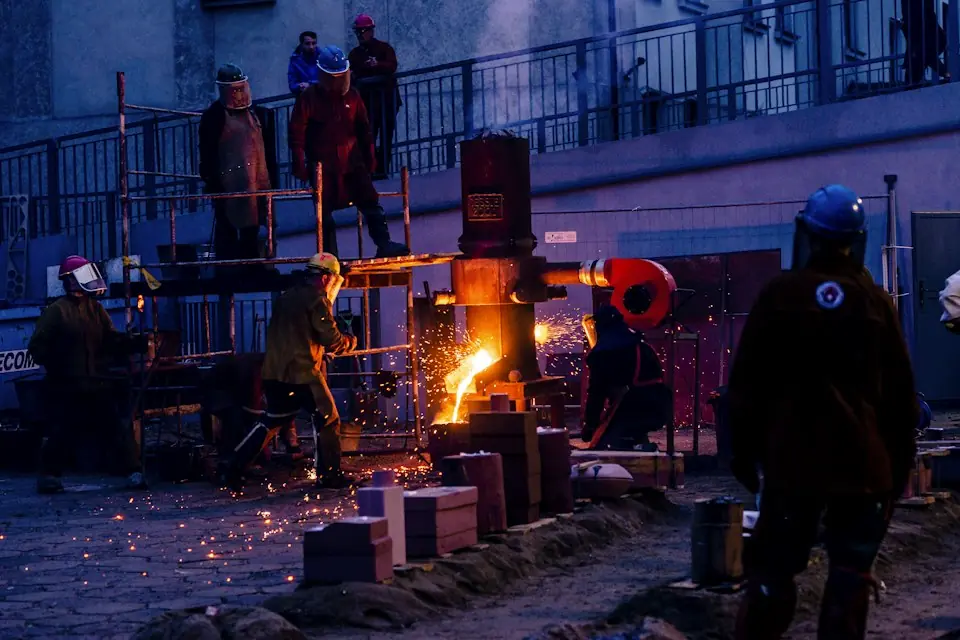
- Hot-workpiece handling requires assessment of personnel safety, tooling deformation, pneumatic-component damage and seal aging.
- Thermal insulation should interrupt heat-transfer paths through insulated contact parts, air gaps and appropriate cooling.
- Position pneumatic lines and components away from heat sources and provide thermal protection, using hoses and seals with suitable temperature ratings.
- Select the mounting arrangement for the heat-source position, workpiece path and operator positions. Overhead or mobile layouts may be evaluated while preserving the required operating distance.
Handling hot workpieces affects operators, gripper contact parts and pneumatic components together. Map heat-transfer paths from the workpiece to the gripper, arm and controls, then provide corresponding insulation, heat dissipation and workstation protection.
01Main risks in hot-workpiece handling
- Personnel exposure: close contact with hot workpieces creates burn and radiant-heat risks.
- Tooling damage: prolonged heating can deform jaws and contact parts, impairing grip reliability.
- Pneumatic-component damage: heat exposure can reduce cylinder and solenoid-valve performance or damage components.
- Seal aging: heat accelerates deterioration of seals and hoses, causing leaks and unstable motion.
02Tooling insulation and cooling
The gripper design should control heat transfer from the workpiece to structural parts, seals and operating surfaces. Select insulating materials, air gaps and cooling methods for contact temperature and duration, and check the service limits of exposed components.
- Insulating contact parts: use temperature-resistant, low-conductivity material at workpiece contact points as the first thermal barrier.
- Air gaps and insulation layers: separate contact parts from the tooling body to reduce conductive heat transfer.
- Heat dissipation: Assess air or water cooling according to heat exposure to reduce temperature rise from sustained heating of the gripper.
- Temperature-resistant structures: select jaws and connectors that retain the required accuracy and load capacity under heat exposure.
03Pneumatic-component thermal protection
High temperature may change the performance or accelerate the aging of cylinders, valves, seals and hoses. Arrange the pneumatic system according to heat-source distance, ambient temperature and operating duration to reduce direct heating.
- Distance from heat: place cylinders, air storage and controls away from the workpiece and radiant heat where practicable.
- Rated hoses and seals: use materials suited to the actual temperatures near the hot zone.
- Heat shields and protection: Add heat shields or protective plates to components that must be close to the heat source to reduce direct exposure to heat radiation.
- Arm and counterweight protection: avoid prolonged heating of these structures and add shielding where required.
04Operator positions and workstation layout
The workstation layout should reduce the need for personnel to approach hot workpieces, allowing operators to observe gripping, control handling and complete release from an appropriate position.
- Mounting arrangement: Assess overhead or mobile structures against site conditions, coordinating the heat-source position, handling path and operator positions. Overhead arrangements also require checks of overhead load capacity and installation space.
- Gripping and braking: verify reliable retention and brake locking throughout hot-workpiece handling.
- Personnel protection: provide suitable heat-resistant gloves, protective clothing, operating distances and warnings.
- Emergency stops and travel limits: coordinate their positions with the handling route to reduce operating errors.
05Configuration by temperature and contact duration
Workpieces differ in temperature, weight, surface condition and contact duration. Check gripper materials, insulation structures, cooling methods and component locations against actual operating conditions. Avoid applying one configuration to every high-temperature application.
| Operating condition | Design focus |
|---|---|
| Lower temperature / brief contact | Insulating contacts and basic protection to control tooling heat exposure |
| Higher temperature / prolonged contact | Insulating contacts, air gaps and air or water cooling; components positioned away from heat |
| High temperature / strong radiant heat | Use multiple insulation layers, heat shields, and heat-resistant materials; prioritize overhead-mounted or mobile configurations to increase separation between operators and the heat source. |
Provide workpiece temperature, weight, contact duration and handling cycle time for project assessment. Use samples or site conditions to check gripping, heat transfer and operator positions, then determine the gripper and protection configuration.