- Vacuum gripping requires a stable, repeatable seal at the contact surface.
- Assess four factors: surface condition, permeability, weight relative to contact area, and stiffness and deformation.
- Cartons, sheet metal, glass, acrylic and flat plastic parts are common candidates. Porous, highly permeable, severely deformed or oily workpieces require closer assessment.
- For uncertain applications, use vacuum tests on actual samples to establish the cup type and array.
Vacuum gripping suits workpieces that can form a stable seal and provide sufficient effective suction area. Cartons, panels, sheet metal and glass differ considerably in surface condition and stiffness. Assess actual samples during selection; material names alone cannot establish suitability.
01Vacuum holding principles
A suction cup uses the pressure difference between its interior and exterior over the effective suction area to generate holding force. Available suction force depends on pressure differential, sealing and effective area. Selection must also account for workpiece weight, handling orientation and load distribution. Raising vacuum alone cannot compensate for insufficient suction area.
02Four suitability factors
Surface condition
A cup must form a continuous seal with the workpiece. Flat, continuous surfaces make contact easier; holes, grooves, ribs, burrs, oil and dust may impair sealing or contact stability. Identify the actual usable suction areas before choosing cup designs and positions.
Permeability
Cartons, wood panels, foam, textiles and some powder-compacted parts may leak continuously. Assess vacuum-source suction flow, cup arrays and system suitability against actual porosity. When using pneumatic vacuum generators, also verify the compressed-air supply. If stable holding cannot be achieved, consider another gripping method.
Weight and effective suction area
Assess workpiece weight together with available suction area. For a heavy workpiece with a small contact surface, distribute suction points and increase effective area. If surface or space constraints still leave insufficient area, use a suitable mechanical gripping method.
Stiffness and deformation
Thin sheets, flexible packaging and low-stiffness workpieces may warp, sag or deform under localized suction. Distribute cups and add auxiliary supports according to the observed deformation to avoid excessive load concentration.
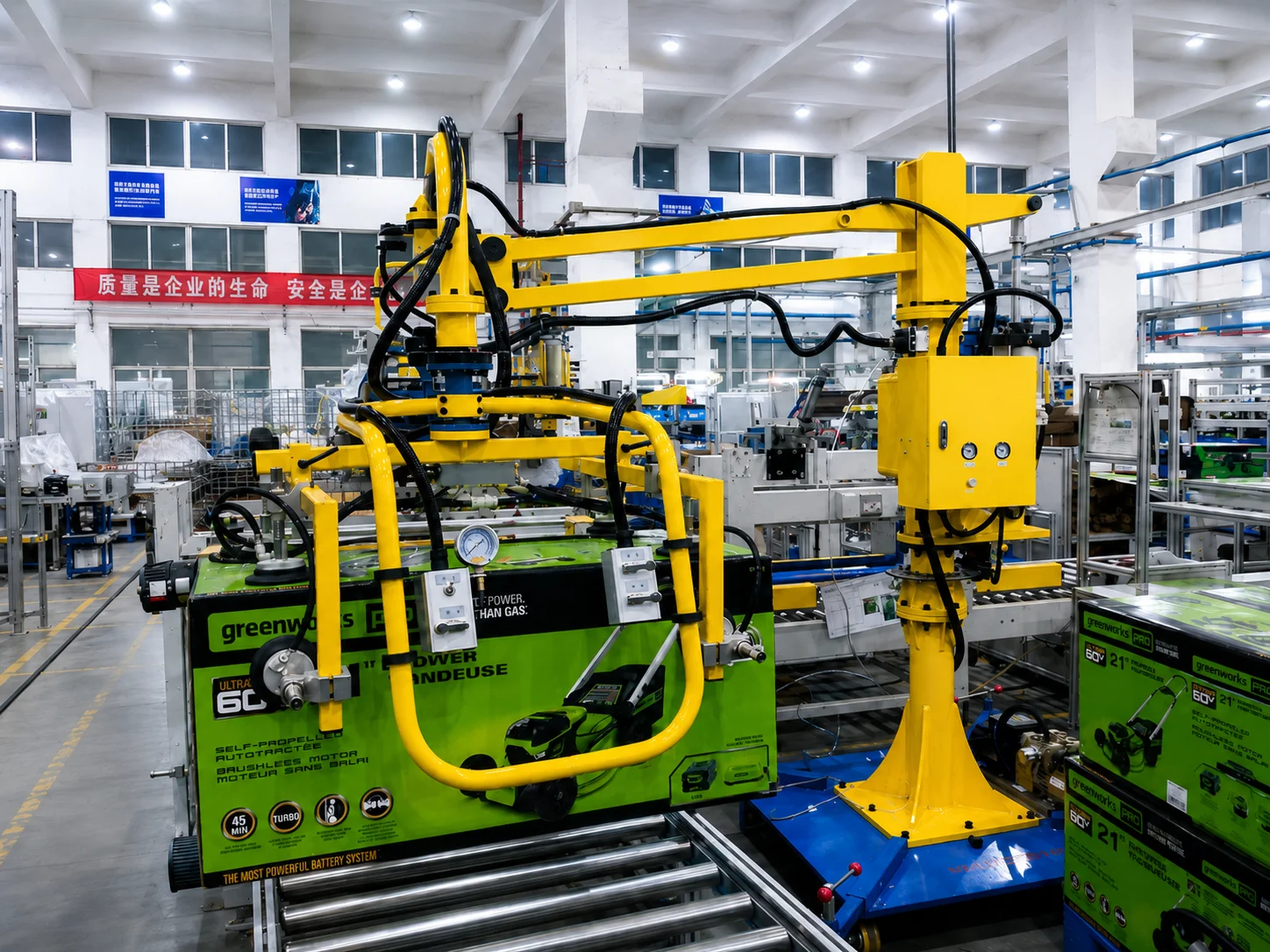
03Material suitability comparison
The table below provides an initial comparison of suction conditions for different materials. Coatings, surface quality and structure can vary even within one material, so assess the specific layout using samples and actual handling movements.
| Workpiece / material | Applicability | Description |
|---|---|---|
| Sheet metal/cover | Suitable | The surface is flat, airtight and has stable vacuum gripping, making it a typical object for vacuum handling. |
| Glass / acrylic / panels | Suitable | The surface is smooth and well sealed. Pay attention to anti-slip and edge protection. |
| Flat plastic parts / injection molded parts | Generally suitable | Requires a continuous flat contact surface; curved or perforated parts need a dedicated cup assessment. |
| Cartons / boxed products | Generally suitable | Vacuum handling is commonly used, but attention should be paid to surface strength, sealing and vacuum gripping area. |
| Wood / porous panels | Requires assessment | High permeability may require greater evacuation flow or a denser array. Use mechanical gripping where needed. |
| Rough / oily / highly permeable workpieces | Often unsuitable | Stable vacuum is difficult to establish. Consider mechanical jaws, internal-expansion tooling or dedicated grippers. |
04When to change the gripping method
- Surface cannot be sealed: Porous, highly breathable, deeply textured or heavily oiled workpieces.
- Insufficient contact area: a heavy workpiece with only a small flat area may not provide enough holding force.
- Deformable workpieces: large, thin, flexible parts may sag or detach under vacuum-only support.
- Pressure-sensitive surfaces: assess cup material and contact pressure for precision or cosmetic parts prone to indentations and marks.
05Improving holding stability
- Multi-point suction cup array: Distributes force and covers a larger area, suitable for heavy and large-format workpieces.
- Cup selection: match flat, bellows or foam designs to the surface, sealing and compliance requirements.
- Match evacuation flow to the required vacuum level: Increase evacuation capacity for slightly porous workpieces to maintain vacuum.
- Cushioning and anti-slip design: Add buffering and positioning structures to reduce slippage and collision during transportation.
- Provide auxiliary supports or lifting supports to share localized loads on low-stiffness workpieces and maintain the handling orientation.
During selection, check sealing surfaces, porosity, effective suction area and deformation in sequence, then match cups, the vacuum system and auxiliary supports. Sample testing should cover actual pick-and-place orientations and the handling process as the basis for configuration assessment.